100th Anniversary of the Harlem Renaissance
  • Blog: Now Observing the Harlem Renaissance Centennial
  • 100th Anniversary of the Harlem Renaissance
    • About the Harlem Renaissance Centennial
    • The Harlem Renaissance and the Year 2020 (continued) >
      • Call for 100th Anniversary of the Harlem Renaissance Papers
      • The Harlem Renaissance Pinterest Project: It's What a Widget's For
  • Text and Meaning in Encyclopedia of the Harlem Renaissance
  • Harlem Renaissance Notebook for National History Day and Black History Month

Timelines: Text and meaning in Claude McKay’s ‘If We Must Day’ (part 4 of 4)

7/27/2021

0 Comments

 
Picture
To read this special Text and Meaning Series from the beginning, please see the links at the end of the article. Part 4 begins now:
 
For those able to accept the image of history as a clock ticking its way along a circular timeline, it is more natural to imagine the hands of that clock moving forward rather than backward. Yet the June 2015 protests in McKinney, a suburb of Dallas, Texas, and the uprising in Baltimore, Maryland, combined with protest demonstrations the previous year in Ferguson, Missouri, New York City, Cleveland, and elsewhere prompted many Americans to question why history appears to be ticking so relentlessly––much like a two-ton bomb built for maximum destruction––in reverse.

Harlem Renaissance author Claude McKay could easily have surveyed the current state of African America––when many, ironically it seems, are observing the 150th anniversary of Juneteenth [adopted in 2021 as a federal holiday]–– and been as compelled now as he was in 1919 to pen the powerful lines of “If We Must Die.” The miracle at this hour, however, may be the remarkable restraint that African Americans continue to exhibit in the face of unceasing aggressive brutality.
​
Whether due in 2015 to the presence of a Black man in the White House or out of respect for the examples provided by Martin Luther King Jr. and others, multiple generations of African Americans have avoided allowing their frustrations erupt into the kind of violence that ended with so many dead during the Red Summer of 1919.


​Equal Demographic Opportunity

The cities named above represent only a handful where African Americans, White Americans, and members of diverse demographic groups in the U.S. turned out to protest the use of deadly violence employed by armed policemen against unarmed Blacks. To be clear, the emphasis often placed on African-American males in no way diminishes the fact that a number of African-American women and girls have also met with such violence. Some––like 47-year-old mother Yvette Smith and Tarika Wilson , lost their lives to it. For that matter, in truth, so have a number of white women and white men.
​
However, a clear enough picture begins to emerge when noting the body count of Black males who have fallen to policemen’s bullets, the number of those who have lost their freedom to the industrial prison complex, and the number of those who have been sidelined by decades of chronic unemployment. Nor has any single population group been so frequently labeled as an object of justifiable fear and subsequently, disproportionately, been tagged as justifiably killed.


​Reinterpreting “If We Must Die”

​Although Claude McKay was working as a “railroad man” when he wrote “If We Must Die,” it was his authority as a recognized poet that empowered him to galvanize a generation and, by doing so, help introduce the Harlem Renaissance. His passionate exultation assisted American history with a major push forward. 
Picture
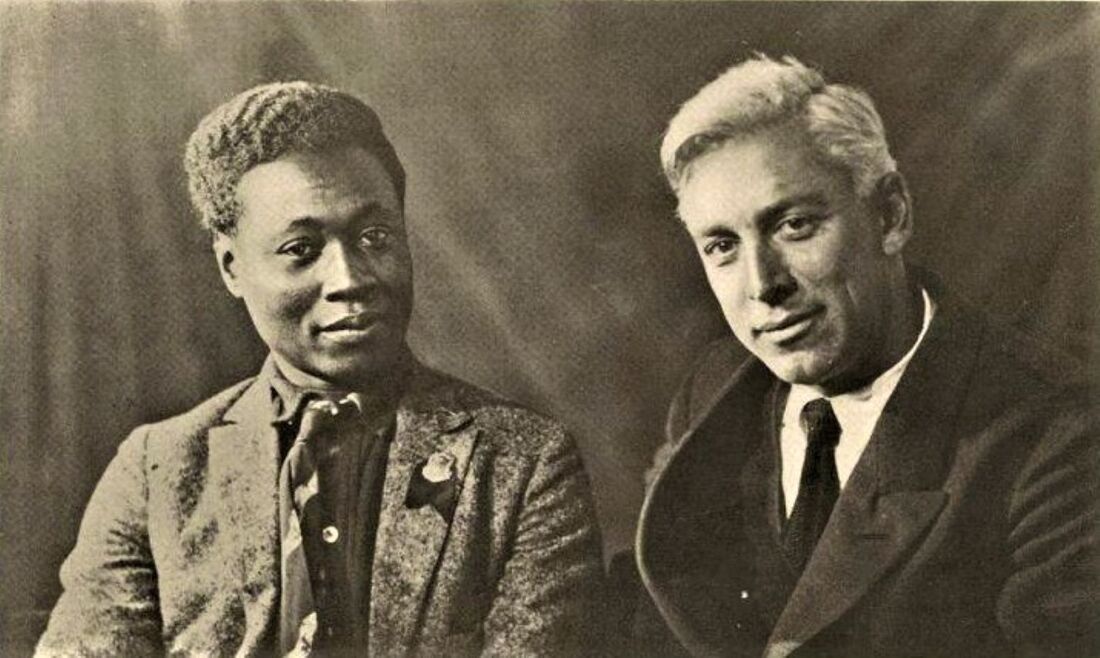
Harlem Renaissance author Claude McKay (left) with magazine editor and publisher Max Eastman in 1922. (Period image by Wide World Photography)
​Because McKay himself was among those to first make it clear that “If We Must Die” was a poetized response to the volatile racial and labor climate of 1919, there seems to be little room for misinterpreting or reinterpreting his conscious literary intentions. Scores of Black men were targeted for lynching in one form or another and those officials entrusted to preserve life and liberty in America did not seem particularly disturbed by this fact. However, when reflecting on the poem during the 1940s, to introduce a recording of it later released in 1954 on Smithsonian Folkways’ Anthology of Negro Poetry, he offered the following:
“…I felt assurance that 'If We Must Die' was just what I intended it to be: a universal poem. And wherever men are pressed with their backs against the wall, abused, outraged, and murdered, whether they are a minorities or nations, black or brown or yellow or white, Catholics or Protestants or pagans, fighting against the terror, 'If We Must Die' could be appropriately read." (McKay, Introduction to “If We Must Die").

​These words would indicate that McKay was at least as concerned about human rights in general as he was about racial equality in particular. 
 
A country in racial crisis, as America surely was when marking the 150th anniversary of Juneteenth Jubilee in 2015, and continues to be 2021, is one with its collective back “against the wall.” That makes McKay’s poem, during this now 102nd anniversary of its publication, a good one to revisit and reflect upon its classic lines for the various levels of insight and applicable meaning they may provide at this specific moment. 

Read the Claude McKay Text and Meaning Series from the beginning:
Red Summer: Text and Meaning in Claude McKay’s “If We Must Die” part 1
Poems Matter: Text and meaning in Claude McKay’s “If We Must Die” part 2
Fighting Back: Text and Meaning in Claude McKay’s “If We Must Die” part 3

Aberjhani
Author of Greeting Flannery O'Connor at the Back Door of My Mind 
Co-author of Encyclopedia of the Harlem Renaissance


    Contact author Aberjhani at Bright Skylark Literary Productions

Submit
0 Comments

Your comment will be posted after it is approved.


Leave a Reply.

    Aberjhani

    Winner of Choice Academic Title Award, Best History Book Award, and Notable Book of the Year Award for Encyclopedia of the Harlem Remaisssance.

    Archives

    July 2023
    February 2023
    January 2023
    December 2022
    July 2021
    May 2021
    February 2018
    January 2018

    Categories

    All
    100th Anniversary Of The Harlem Renaissance
    1920s Jazz Age
    21st Century's Most Important Books
    Aberjhani On The Harlem Renaissance
    Academic Texts
    Actress Jasmine Guy
    Advanced Placement African American Studies
    Advanced Placement African-American Studies
    African American Artists
    African-American Artists
    African American Authors
    African-American Authors
    African American Communities
    African American Creatives
    African American History Month
    African-American Holidays
    African American Leaders
    African-American Leaders
    African Americans
    African American's Greatest Generation
    African Americans In Savannah
    African American Writers
    African-American Writers
    African America's Greatest Generation
    America In Crisis
    American Libraries
    Anti Racism
    Anti-Racism
    AP African American Studies
    AP African-American Studies
    Art By Aberjhani
    Artist Kevin Pullen
    Arturo Schomburg
    Author Poet Aberjhani
    Author-Poet Aberjhani
    Award Winning Books
    Award-Winning Books
    Barack Obama
    Best History Book Award Winner
    Black Arts Movement
    Black Creatives
    Black History Month
    Black History Month 2023
    Black History Month Reading List
    Black Journalists
    Black Leaders
    Black Lives Matter
    Black People In America
    Black People In The USA
    Blogs By Aberjhani
    Books By Aberjhani
    Books By Black Authors
    Books By Sandra L. West
    Boris Vian
    Calhoun Square In Savannah GA
    Carlos Fuentes
    Carter Woodson
    ChatGPt Blogs
    Chicago Defender
    Choice Academic Title Award Winner
    Classic Poetry
    Claude McKay
    Clement Alexander Price
    Compassion
    Contemporary Classics
    Creative Artists
    Creatives
    Creativity
    Cultural Arts
    Dallas Texas
    David Thoreau
    Democracy In Action
    Diversity
    Dreams Of The Immortal City Savannah
    Edgar Allen Poe
    Editorial
    Education Week
    El
    El Boom Literary Movement
    Emily Dickinson
    Encyclopedia Authors
    Encyclopedia Of The Harlem Renaissance
    Encyclopedias
    Encyclopedists
    Eric Holder
    Ernest Hemingway
    Essays By Aberjhani
    Essays On The Harlem Renaissance
    Facts On File
    Film Industry In Savannah Georgia
    Gabriel Garcia Marquez
    Georgia Day
    Georgia Historical Society
    Gertrude Stein
    Greatest Generation Of African Americans
    Greatest Generation Of Black Americans
    Greatest Generation Of Black People
    Great Northern Migration
    Guerrilla Decontextualization
    Gullah Geechee Heritage
    Harlem Renaissance Artists And Poets
    Harlem Renaissance Centennial
    Harlem Renaissance Historians
    Harlem Renaissance Leadership
    Harlem Renaissance Musicians
    Harlem Renaissance Silent Parade
    Herschel Walker
    Historian Of The Harlem Renaissance
    Historic Photograph
    History Day
    History Making Poems
    History-making Poems
    History Making Poets
    History-making Poets
    History Of African Americans
    History Of Harlem New York City
    History Of Literary Movements
    History Of The Harlem Renaissance
    History Week
    Humanities
    Human Sexuality
    If We Must Die By Claude McKay
    Ilan Stavans
    Important Books Of The 21st Century
    Influential Books
    Influential Books Of The 21st Century
    Influential Poems
    Influential Poets
    Infobase Publishing
    International Authors
    Isabel Allende
    Jean Paul Sartre
    Julio Cortazar
    Juneteenth
    Leadership
    Leadership Strategies
    Libraries
    Life Expectancy Of African-American Men
    Literary Activism
    Literary Milestones
    Literary Resources
    Loretta Lynch
    Luther E. Vann
    Marijuana Legislation
    Mark Twain
    Max Eastman
    Maya Angelou
    Michelle Obama
    Multiculturalism
    National History Days Topics
    Nella Larsen
    Nobel Prize In Literature
    Notable Book Of The Year Award Winners
    Occupy Movement
    Official Harlem Renaissance Website Of Author Poet Aberjhani
    Official Harlem Renaissance Website Of Author-Poet Aberjhani
    Omniculturalism
    Op-ed
    Poems By Claude McKay
    Police Reform
    Political Activism
    Political Dissent
    Practicing Democracy
    President Obama
    Public Protests
    Publishing
    Quotation Art
    Quotes By Aberjhani
    Quotes By W.E.B. Du Bois
    Quotes On The Harlem Renaissance
    Racial Crisis
    Racial Protests
    Racism And Antiracism
    Reading Lists
    Robert S. Abbott
    Robert Sengstacke Abbott
    Sandra L. West
    Savannah Day
    Savannah Georgia
    Savannahians
    Sen. Ralph G. Warnock
    Sexual Identity
    Simone De Beauvior
    Social Activism
    Social Media
    Social Unrest
    Stop And Frisk Laws
    St. Simon's Island Georgia
    The Lost Generation
    Tourism In Savannah Georgia
    Walt Whitman
    W.E.B. Du Bois
    W.O.K.E. And ChatGPT
    Women Artists
    World AI Week
    W.W. Law
    YouTube Video

    RSS Feed

Proudly powered by Weebly
  • Blog: Now Observing the Harlem Renaissance Centennial
  • 100th Anniversary of the Harlem Renaissance
    • About the Harlem Renaissance Centennial
    • The Harlem Renaissance and the Year 2020 (continued) >
      • Call for 100th Anniversary of the Harlem Renaissance Papers
      • The Harlem Renaissance Pinterest Project: It's What a Widget's For
  • Text and Meaning in Encyclopedia of the Harlem Renaissance
  • Harlem Renaissance Notebook for National History Day and Black History Month